
Vietnam and City of Belief
December 27, 2017 § Leave a comment
Everyone has an opinion on the Vietnam War as well as everyone has an opinion on the recent Ken Burns documentary on the Vietnam War. My first book, City of Belief, documents, under the guise of historical fiction, my and my friends’ coming of age experiences during that time. We have become and are a part of our country’s disparate, contradictory and combatitive historical memory of that chapter in American history.
A little over a week ago, I was in Vietnam as part of a Habitat for Humanity Global Build in the Mekong Delta. I went with two friends who I worked with at the Catholic Worker in the 1960’s, Dan Kelly and Paul Mann, both draft resisters during that war. Dan served two years in federal prison and Paul, sentenced to three years, had his jail sentence reframed to serving time in National Service.
I landed in Tan Son Nhat airport on December 2 and walked out into Ho Chi Minh City but part of me landed in the old Saigon and news reportage circa 1960’s in my head of that airport under attack. These were superimposed images that would come from time to time as I visited locations that were, in my early twenties, always flickering on tv screens in American living rooms or being written about with fervor in newspapers. Indeed, as the Ken Burns series has revealed and our current political climate in the United States continues to reveal, we remain a nation divided on that war and on any number of political and social issues that were the cultural spin-offs from that era.
That said and because I have my own “take” on what I experienced during that time, I am going to present via this blog a little slice of what I saw in Ho Chi Minh City that has a direct bearing on experiences re-imagined in City of Belief.


The first day walking around Ho Chi Minh, Paul took us to see the memorial to Thich Quang Duc who on June 1963 immolated himself on a Saigon street protesting the persecution of Buddhists by the South Vietnamese Government. The photographic image of that somber act appeared in newspapers across the world and was one of the first images to be burned into the psyche of the American public. In some ways, it introduced the complex ferocity of that war. The three of us visiting the memorial placed sticks of incense on the alter and watched as the thin, wavering trails of smoke lifted up along with our private intentions.
Next we went to The War Remnants Museum. The following three photographs are displayed in a section of the museum devoted to the story of United States protest to what is referred to in Vietnam as the American War.
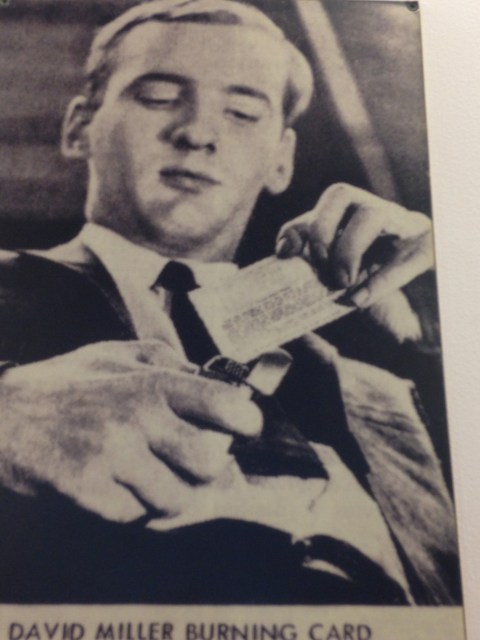
The first photograph is that of David Miller, Catholic Worker friend and colleague, who in September 1965 was the first man to publicly burn his draft card after President Lyndon Johnson made it a Federal crime to do so punishable by 5 years in prison. Dave subsequently served three years for draft refusal.

The second photo found in the museum is that of the public draft card burning in Union Square in November 6, 1965. On the left is Tom Cornell, a founder of the Catholic Peace Fellowship, next is Mark Edelman, a cabinet maker, alongside him is Roy Lisker, a teacher, next to Roy is Jim Wilson, a Catholic Worker friend and colleague and the youngest of the draft card burners and, finally, David Mc Reynolds of the War Resisters League. For those of you interested in some archival footage that depicts the tumult of the time, the following PBS account is accurate.
Finally, the last photo and most jarring for me, is of our friend and Catholic Worker colleague, Roger La Porte, who immolated himself in front of The United Nations in NYC in the early hours of Nov. 9th, 1965. His story, as I recall it, is told in City of Belief.
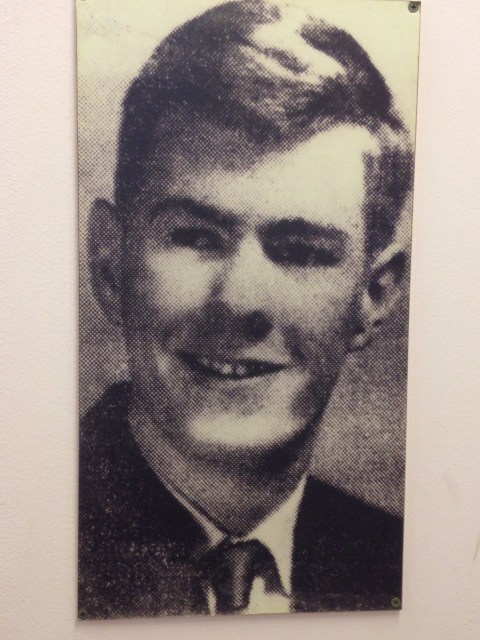
We were all young and the war in Vietnam is our story also. All of us have made our separate peace. May our country do the same.
Chekov’s Gun and Le Stylo Préfére
July 19, 2017 § Leave a comment

What could Chekov’s gun have in common with a fountain pen? Did Chekov want the gun if mentioned in the first act, discharged in the second act or by the conclusion of the play? You might tussle with that question in a playwriting course or literature class. You might even have a hot debate about it, some academics even might come to blows, but in the end what happens to that gun or to that pen or, let’s say, to a letter brought conspicuously into a scene yet left unopened. If so, that letter will scream throughout the performance, “Open the damn letter”and if not opened, the audience would squirm in their seats as if sitting on velcro. Such, also, is the power of the prop and the power of the stage-hand who must place the prop in the right place, the right time, the right viewing angle and, yes, be quick and quiet about it.
In Le Retour, a pen plays a central role. I won’t say what happens to said pen or why it plays that role. You’ll need to come and see a performance of the play or follow us to Belgium in the summer of 2018 to get the answer. I didn’t even know the pen would factor so significantly when I started writing the play. Except, now, keying in this blog entry, I see in my mind the spidery, ink scribing of the priest’s grade entry for my young Uncle Léo (circa 1912, College Saint Anne, Church Point, Nova Scotia) where Léo went to school before he enlisted in the Royal Canadian Regiment and sent to war. He never came home. Now, almost 100 years later, we are remembering and bringing those ghosts back. They have words for us whether through pens or keyboards. We need to look and to listen to what they have to say.
On The Road To Belgium(1)
July 17, 2017 § 1 Comment
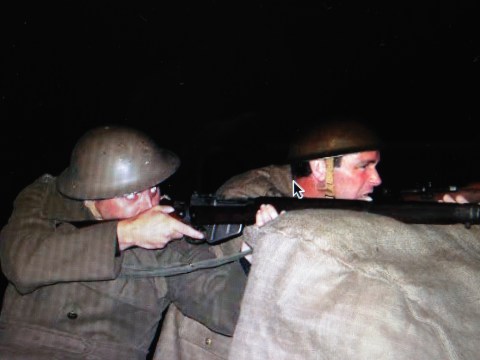
Scotty and Léonce behind the trench in Ypres, Belgium, 1916
“A flare, man!” At home, miles and miles away, the family recites the rosary.
Théo, the youngest Boudreau boy, sees, Elzéar, the second son who went to war, walking up the lane.

Soldier’s Home

But, someone followed or did he?
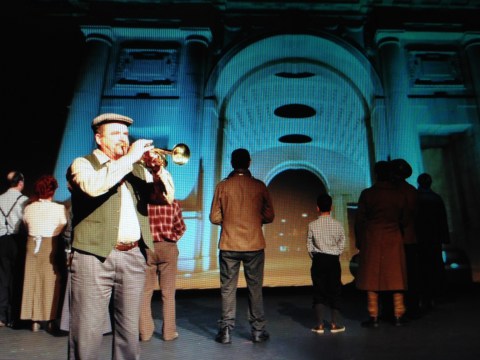
Final scene before the Menin Gate.

THE CAST OF LE RETOUR/ FOLLOW US TO BELGIUM 2018
Flash Sketches from Andre
July 5, 2017 § Leave a comment
 Last night, during our last rehearsal before the final dress rehearsal, a man sat in the audience and sketched away catching evocation through movement and gesture. In the sketch above, we see the blur behind the trenches and below,”Give me a ‘gasper’, man.”
Next, soldier’s home.

Or, is he?
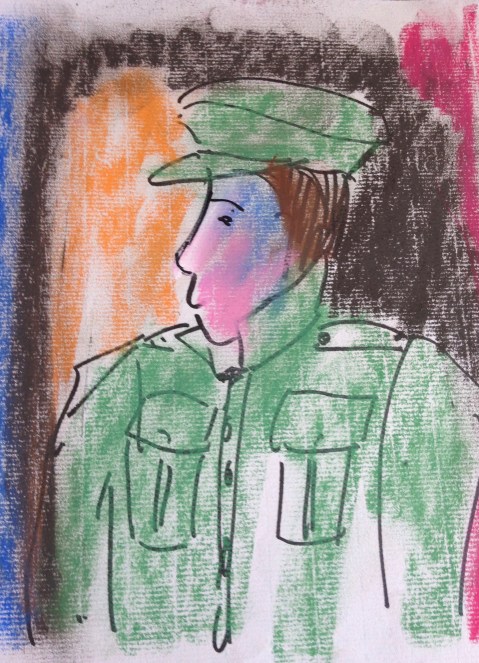
The Rosary

Finally, “They teach you a lot of things in war but……….
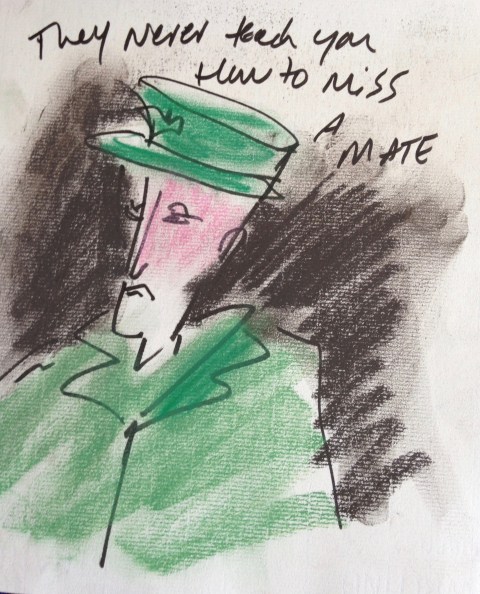
Enough said.
The Vanguard Article
July 4, 2017 § Leave a comment
In three days, the play has its début. Here is the recent article published in Nova Scotia’s Tri-County Vanguard.
Début de Le Retour
May 26, 2017 § Leave a comment

The début of Le Retour will take place at Salle Père Maurice in Tusket, Nova Scotia this summer on July 7, 2017 with a second performance scheduled for July 14th. This will also mark the birth of a new theatrical troupe, Théâtre Générations. In many ways, we are a troupe spanning the generations ourselves from 70 years to 8 years and all ages in-beteen. Our common bond is our allegiance to one another and our ancestral bond to Nova Scotia. Acadian and English blood runs through our veins, the same mix of blood spilled on the far-flung battlefields of WWI.
The story of Le Retour is not a new story. There was a war. Governments ordained and men (often boys) went to fight in that war. Families were involved. In our story, two brothers enlisted in the Royal Canadian Regiment during WWI. One came home from that war, one did not. What is new about that story? It’s such an old, old story but one continually new to the families who experienced it, even now, almost 100 years later.
What is the return home like for the soldier who has been and who has done what he has been required to do in that other life that is now over. But, is it really over?
My father was seven years old when his oldest brother, Léo, enlisted in the Royal Canadian Regiment in 1915. Ten months later Léo was reported missing and then killed in action in Ypres, Belgium. His body was never recovered. His name is now engraved on the Menin Gate along with the more than 55,000 other names of the missing whose bodies were never found.
The next son in that family, my Uncle Felix, lied about his age and also enlisted, but four years later, he came home to the village. Le Retour imagines that story. The story of the boy who comes home.
I am writing this Blog entry on Memorial Day weekend, 2017, in the United States of America. On Memorial Day, I will think of my two uncles. Next summer, 2018, Théâtre Générations plans to go and present our play not far from the Menin Gate where every evening since 1928, traffic stops, people gather and bugles sound in remembrance of those whose names are engraved on that wall who have no known grave.
http://www.lastpost.be/en/ceremonies/participation
It is a simple and dignified ceremony. I was there once and I look forward to participating again in 2018. I was moved by the ceremony because it was simple and for the few words said and the silence of those gathered and the haunting loft of the buglers’ notes that rose in the still air. For my own part, I did not want to hear patriotic words. I did not want to hear praise for sacrifice although sacrifice there was and valor and, I am sure, its concomitant of regret for some actions done. That is what soldiers endure when they come home from war, if they come home, and what they and their families must bear up and until today in this year 2017.
For those of you who can, please come to our production this summer. All this year and into the next, we will be raising money for our troupe to travel to Belgium in June of 2018. We have already garnered a generous donation of $1,800 from the Municipality of the District of Argyle to assist us in presenting our play in Ieper, Belgium and, hopefully, we will be presenting Le Retour in other venues in the maritimes.
In the next few weeks, while we are in rehearsal, I hope to post some clips on these pages for you to see a bit of our process and also in order to introduce you to the cast.
For now, as befits this Memorial Day weekend, I will close with the sculpture of The Brooding Soldier, St. Julien Canadian Memorial at Vancouver Corner, Ypres Salient, Belgium.

The Brooding Soldier was designed by Frederick Chapman Clemesha, an architect from Regina, Saskatchewan. Clemesa, himself, had served in the Canadian Corps during the war and had been wounded.
The Gate
May 4, 2017 § 1 Comment
Menin Gate At Midnight by Will Longstaff, 1927
 As you look closely, the spectral soldiers appear in Will Longstaff’s 1927 painting as they move through the Menin Gate toward the Western Front. The Menin Gate Memorial was dedicated in 1927 and on its 59 panels are listed the more than 55,000 men killed at Ypres (Ieper) whose bodies were never found. My young uncle, Léo, is one of those. Perhaps hidden in that very darkness, he advances toward his fate.

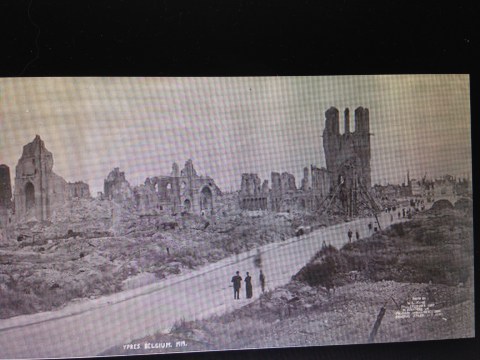
Of course, in 1916, there was no memorial gate, only the scarred road in the photograph below leading to the trenches. The husk of the Cloth Hall and the destroyed remnants of Ypres (now bearing its Flemish name, Ieper) are behind them. One can only imagine the thoughts they must of had while marching.
The Menin Gate Memorial now stands astride that road leading out of the city to the then devastated lands known in the history books as, “the Salient” where 200,000 British Commonwealth lives were lost. Over the course of the war, 1,700,000 soldiers on both sides were killed or wounded around Ypres and an uncounted number of civilians. The last shell fell on what remained of the city on the 14th of October, 1918.
On a warm summer’s day, Sunday, July 24th, 1927, the Menin Gate Memorial was dedicated. Five hundred piles were driven 40 feet deep to ensure a stable foundation. Thousands of unexploded shells were painstakingly removed . Six thousand tons of stone, 11,000 tons of concrete, 500 tons of steel. With the weight of the panels and sculptures, the Menin Gate Memorial weighed 20,000 tons.

Thousands attended the ceremony including 700 mothers who had lost sons in the war. A view through the arches will give you a glimpse of how the city was beginning in 1927 to be restored. If we had been there in that crowd that morning, we would have heard Field Marshall Lord Plumer, former commander of the British Second Army, address his remarks directly to the families of the missing by stating that the memorial had been erected to be worthy of those who gave their lives and was an attempt to give them an expression of the nations’ gratitude for their sacrifice and to show sympathy for those who mourn. Lord Plumer continued that the memorial, “In its simple grandeur, fulfills this object, and that now it can be said of each one in whose honor we are assembled here today; ‘He is not missing; he is here’.” He is here. For my young uncle Léo, even at this remove, I wonder what he would say. But, that is my speculation this spring day almost 100 years after the conclusion of that war to end all wars.
Next year, in June of 2018, our theater group, Le Théâtre Générations, plans to present our play, Le Retour, in a venue not far from the Cloth Hall and The Menin Gate in Ieper, Belgium. Some members of our group are as young as the young men who served in that war, some members as old as their mothers or fathers, some as young as children in the families who said goodbye in front of steamships or trains. All of us carry that war in our historical memory, in our own family histories. In some sense, maybe we will all be returning.
After the war, Paris, December 9, 1918
April 24, 2017 § Leave a comment
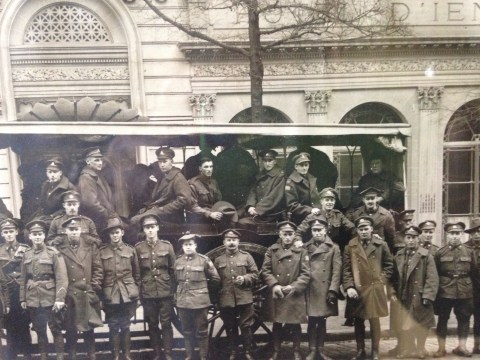 Hotel d’Iéna where the YMCA sheltered Canadian troops awaiting discharge papers after WWI.
My friend, Eleanor Morse, found this photograph in a Curiosity Shop in Parsonfield, Maine. The framed photo hung on the wall before my desk as I was writing, A Generation of Leaves, the book that was to become the springboard for the play Le Retour which will be performed this summer in Nova Scotia and, hopefully, in Belgium next year as part of events marking the conclusion of the Centenary commemoration of WWI.
Often, especially as I was reaching the ending of A Generation of Leaves and my spirits would flag, I would look up at the silent faces of those men, those ghostly apparitions from the past, those men who made it through the war to end all wars. They were going home and that was another story. They were going back to mothers and fathers and sisters and brothers, to wives, to children, to lovers and maybe to no one in particular. But back, hopefully, to work, to fields or oceans, maybe to school, to life. But what did they carry within them, what stories, what visions. Look deeply into any of those faces and try to imagine. It shouldn’t be hard. Certainly we’ve had the practice having had so many wars since the one to end them all.
Grass
April 10, 2017 § 1 Comment

The Battlefields in Flanders WWI
April is the cruellest month, breeding /Lilacs out of the dead land/mixing memory and desire……..I am copying this from my college literature text Modern Verse in English 1900-1950 edited by David Cecil and Alan Tate. My hardback copy of 688 pages was $3.85 in 1960 complete with my erudite marginalia referencing T.S. Eliot’s The Waste Land. I found the poem as dreary then as I find it dreary and self-absorbed now, riddled with obscure references and sly nods to contemporary speech. I don’t think I received a stellar grade in that course. But, often a poet is redeemed for me by a memorable line and I think Eliot’s mixing memory and desire touched such a nerve.

The Battlefields today in Flanders
Six years ago when I went to the WWI battlefields surrounding Ypres in Belgium, I woke to a misty morning outside the city of Ieper (the reclaimed Flemish name of the city). Looking out the window, I saw only green grass and mist and heard birdsong. This was the city where my young Uncle was somewhere buried in an unknown spot. This was the family story, the family memory and, for me, now, the desire to tell that story. That urge in itself is one of the oldest stories. Why we can’t forget. Why we want to construct memory out of the rag tags of history. So, I visited the trenches. I walked through a few, startled that my shoulders went to the lip of the trench. In 1914, they would have been fortified at the top with sandbags and soldiers were smaller then. I heard the skirl of bagpipes played by a man pacing in Sanctuary Wood where many Canadian forces had lost their lives. I walked through many sun-splashed graveyards where Commonwealth graves are impeccably kept. I saw one German gravesite that my guide took me to and wondered how shaded, dark and somber it was, wondered if that were some kind of retribution for their part in the war and was told no, the Germans wanted it that way. They felt their fallen would like to be in a shaded spot that reminded them of the sheltering, black forests. My guide pointed out, “There, there was this spot for that attack and that spot for the counter-attack”. This high ground, that low ground. I saw fields of green and heard birdsong and felt a soft breeze. Memory and Desire.
In 2018, the Commemorations of World War One, the Great War to End All Wars, will conclude. Our little theater group from Nova Scotia will travel to Belgium to present our play Le Retour. We will walk on the earth that holds the bones of our relatives. There will be green grass and mist and birdsong mixed with memory. What will our desire be then?
I am reminded of another poet, Carl Sandburg, whose poem Grass references the battles of Waterloo and Austerlitz, Gettysburg, Ypres, and Verdun. Pile the bodies high, the poet says/I am the grass. Let me work. Today on April 10th, 2017– Can we do better than letting the grass cover what we have undone?
 A Generation of Leaves