
Stories/Twice Told
March 21, 2017 § 2 Comments

Works of literature attempt a twining of lives observed, heard, felt and then joined through leaps of imagination. Le Retour, the play to be performed this summer in Nova Scotia, is no exception.When I first began writing the play, I knew it would be the story of two brothers, one who came home to his village from WWI and one who did not come home. But, how that would shake out, the words that would be spoken, the actions taken, the twists and turns of plot unfolding often came as a surprise.
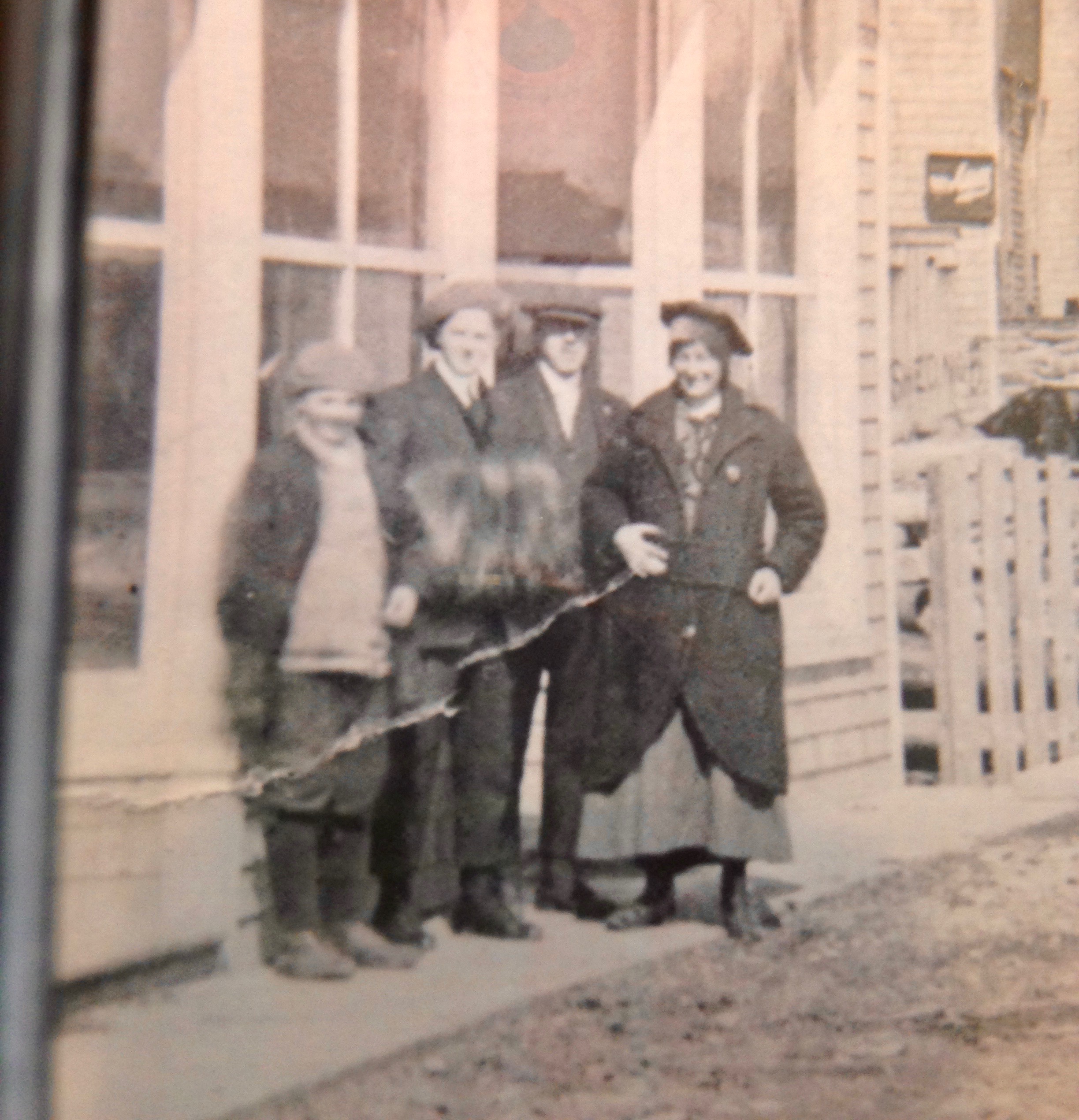
The solemn face of the young boy appearing above sitting between two other boys is that of my Uncle Felix who becomes Elzéar in the play, the brother who came home. He sits between Henry Amirault and Louis Leblanc in this photo taken around 1912 in front of the Middle East Pubnico School. In December of 1915, he will sign up with the Canadian Expeditionary Force. He will be 17 years old. He will disembark in England, July 1916. His older brother, Léo, had already left for France and Belgium by November 1915 and was reported missing then killed in action by June 1916. Those were the facts recorded bloodlessly in official documents. The spidery handwriting revealing only dates of embarkation and destination: In Léo case it was Embarkation for France, Reported missing/ After action between 2nd to 5th June, 1916. Now killed in action/Field.” The trajectory of life in the trenches.
I wanted my play to fill in the gaps of those pitiful notations. For that, I wrote a book and researched the war. For that, I wrote a play so that living,breathing actors could fill their lungs and live the parts of those two young men, say the words that “officialdom” could never say.
There is one story embedded in Le Retour that Felix told his oldest son, Francis “Pierre” d’Entremont who died earlier this year, that is dramatized in the play. It is told in an exchange between two characters. I won’t reveal the story now. You’ll need to come and see the play. But the next story is one I will share. It is not in the play but George David d’Entremont, the son from Felix’s second marriage, told me it last night on the phone. It was one his father had told him when he was a boy.
Felix, hardly more than a teenager himself, was on sentry duty in France. One night, a German Officer appeared out of the dark approaching from behind, startling him. There were initial moments of fear but it soon became apparent that the soldier was not threatening, but trying to explain something in German and Felix was responding in English. At some point, they both realized that they both spoke French and the details of surrender were worked out. The German relinquished his sidearm and Felix prepared to walk him back to the authorities. But before he did that, knowing, once in custody, the soldier might be mistreated, Felix took the man’s valuables: his watch, ring , some photos and pinned them for safety under the lapels of the German’s greatcoat so they wouldn’t be taken before turning him over to the Allied position. A moment of decency in that fratricidal war between brothers and cousins who more often than not shared at least one common language between them as well as common borders.
We plan in June of 2018 to bring Le Retour to Ieper, Belgium, the Salient where so many Commonwealth and German soldiers lost their lives. The dialogue in Le Retour is written in le français acadien and English and while in Flanders it will be translated also into Dutch, the translation then projected onto a screen to the side of the stage. This was at the request of our hosts in Belgium. It would be wonderful if the play could be translated into many languages. It’s intent is a universal tongue.
Commencer/To Begin/Le Retour
March 7, 2017 § Leave a comment
To begin, what do I know about my Uncle Léo? He was born November 17th, 1893. At 22, he enlisted in the Royal Canadian Regiment, August 21, 1915. He disembarked, November 1915 in Boulogne. He was reported missing then killed in action, Belgium,Ypres, June 5th, 1916. He was 23 years old. Between the arc of those two events, he had his life on this earth.
What else do I know? When he enlisted with the Over-Seas Canadian Expeditionary Force at 22, he put down his trade as Grocer. He was not married. He was described by the examiner as being five feet ten, his chest girth when fully expanded was 37 and 1/2 inches, for distinctive marks he bore a large, circular scar on right leg, his complexion dark, his hair black, his eyes blue grey, his religion, Roman Catholic. What is not reported is that he was the eldest in a family of 11 children. He lived in the small, Acadian fishing village of Pubnico on the south shore of Nova Scotia. He had attended the College Sainté-Anne (now the Université Sainte-Anne) for two years. He was a good student. The one photo I have of him shows him with friends in Meteghan. According to Celestine, writing on the back of the photo, The boy next to me is Leanor, next is Léo d’Entremont,”Ain’t he cute?” He’s got my muff. Next is le petit Robert.
Léo w/Celestine’s muff
My ghostly Uncle Léo. And why do I care? Many reasons, one being that I am probably the last generation who will remember, even at this remove, a relative who died in the Great War, as we anglais refer to it, and, also, because I’ve spent most of my adult life, up to and including this year of 2017, resisting war. I am drawn to its human story. What it does to families. How we look for and try to find the missing. How we grieve for those who do not come home and for those who do come home. How we calculate what is gained and what is lost. Le Retour as well as its predecessor, A Generation of Leaves, wrestles with these questions.
LE RETOUR
February 22, 2017 § 3 Comments
It has been two years since I entered any notation into this Blog. However, I wish to use it now to chronicle the evolution of my book, A Generation of Leaves, into the play, Le Retour, which will be presented this summer (July 2017) at two venues in Nova Scotia, Canada. The play will be performed at Le Village Historique Acadien de la Nouvelle-Écosse https://levillage.novascotia.ca/visit-us and Le Père Maurice-Le Blanc Theatre in Tusket, Nova Scotia. At this point, we are also launching our funding efforts to bring the play to Ieper, Belgium as part of concluding WWI commemorative events in Europe.
Our official promotion of these productions was recently announced in the Yarmouth Vanguard. The news article includes our promotional video shot on location at Le Village. Please check it out.
My own efforts regarding this project began in 2014 with the dramatization of the first part of the book presented on the Le Village amphitheater stage. That production concluded with a haunting trumpet solo before a replica of the Menin Gate in Ieper, Belgium.

Last Post/The Menin Gate
In the WWI literature, Ieper, is referred to as Ypres. Now the city bears its Flemish name. The Menin Gate is legendary in the First World War and engraved on its panels are the names of nearly 55,000 Commonwealth soldiers who died in defense of the city and whose bodies were never found. My Uncle Léo’s name is on the gate. He was 23 when he was killed in the Battle of Mont Sorrel along with many Canadians who perished while defending the city.
I want to use these pages to document our progress both while performing the play this summer and our efforts to travel to Belgium in 2018. My next posting will include information about the cast and characters involved in Le Retour.
FIFTY YEARS AGO
December 21, 2015 § Leave a comment
November 2015 marked the 50th anniversary of two crucial events that sparked the book City of Belief: the draft card burning held in Union Square in New York City on November 6th, 1965 and the immolation of Roger La Porte on November 9th, 1965 in front of the United Nations. Both of these events changed my life and the lives of my friends. Both of these events were remembered in New York City last month at the Catholic Worker’s Maryhouse: one event reflected on the draft card burning and the other event was a vesper service for Roger La Porte. Those of us who had been directly touched by those days are now in our late sixties or seventies, some in their eighties. But others at those remembrances were younger yet they too have been and are being touched by the laundry list of wars our country has been involved in since the war in Vietnam. It would be fruitless to go into a debate about the war in Vietnam at this remove, but it shouldn’t be fruitless to reflect on what we did then with our young lives and what we are currently doing now unless you think personal reflection gets you no where–a posture that gets everyone off the hook.
Most of my male friends during that era went to jail from two to three years for actively resisting the draft, some went to Canada, one childhood friend went to Vietnam and his name is engraved on the Vietnam Veterans War Memorial Wall. My friends who resisted the draft became, for example, a pediatrician, a librarian, a social worker, a writer, a photographer, a carpenter. A childhood friend who also resisted is currently in Vietnam with Habitat for Humanity helping build homes in the Mekong Delta finally, as he puts it,”Answering my country’s call.”
And what today is our country’s call? We might have a hard time answering that question. But, in January 1961, we listened on a cold, windy day in Washington, D.C. to a young, Irish-Catholic President take the Oath of Office who challenged us not to ask what our country could do for us, but what we could do for our country. Can you imagine any political figure today daring to pose such a question? It might be time to ask ourselves why and after we’ve answered that question to our satisfaction… Ask why again.
Christmas Truce, 1914
December 17, 2014 § Leave a comment
The Christmas Truce, 1914
Many years before I started to write A Generation of Leaves, I heard John McCutcheon’s ballad, Christmas In The Trenches, sung at a small gathering on Christmas Eve where some dissident Catholics were having a service in a Quaker Meeting House. A lone guitar player sang out with his clear tenor where a group of maybe twenty of us were gathered in a room lit with candles. I knew little about WWI then and nothing about the fields of Flanders where my young Uncle Léo’s bones someplace rested in an unknown, unmarked grave. I know a lot more now but the lesson I learned that night with John McCutcheon’s song tells the story of that war as true as any novel. During WWI there were other spontaneous truces all up and down the Western Front where men on both sides disgusted and disheartened with the slaughter made up their own minds not to shoot but to live and let live. Here is the story of that first truce.
http://www.dailykos.com/story/2012/12/24/1173542/-Christmas-in-the-trenches-A-true-story#comments
Small moments within the big story
December 11, 2014 § 2 Comments
It’s been a long time since I’ve written in this blog. I’m really not a blog person. I’m more a muller—mulling this and mulling that before I’m ready to commit but last week I spent my days and nights in New York City and that has speeded up the process. I try to visit NYC every year especially since I returned from time away in San Francisco and Albuquerque. New York was where I came of age to use that quaint expression that captures both innocence and experience. I lived in the Lower East Side for roughly ten years from 1964 to 1973. I returned this past week to visit my friend, Fran, and to give a benefit reading at The Catholic Worker, the movement that has been offering food and shelter to the homeless and the searching since the 30’s without benefit of financial help from any governmental agency and surviving on private donations of money and labor. In the 50 years between when I first came to the Worker and now, the Lower East Side has changed drastically. The Bowery is no longer skid row, tenements are now luxury high rises, a cuppa joe costs five bucks not 50 cents. I walked around as I usually do locating the old haunts—Chrystie Street where we had the soup kitchen now houses some kind of catering outfit. The church where I was once married is not Puerto Rican anymore but Pilipino. Chic bars and cafés seem to dot every block, wifi is ubiquitous. The Café Roma on Broome Street is the same and I stopped in for a cappuccino. Katz’s Deli is the same and the late night hubbub and the mountainous pastrami sandwiches haven’t changed. More than anything, what changed this past week was my own attitude. I wasn’t looking for the shade of my younger self anymore or the ghosts of my past. It’s a little hard to tease out the meaning of what I have just said and I know the mulling will continue but I want to put down a few things now. Number 1 is I bought a week long Metro Card pass which meant I could zip around the city on the subway or bus without worrying about screwing up and missing my stop. Why I never did this before I don’t know. Money, I guess. Money always has a lot to do with attitude. Number 2 was that right before I bought my Metro Card, I helped a woman buy her ticket at the computer kiosk. I hate even buying my own tickets at those machines since I often mess up and there are usually people standing behind you wanting you to go faster. But no one was around and she was standing there and looking at the machine and she asked me if I read English and if I could help her and I said yes thinking also, right away, that she probably wants me to buy her the ticket. I hit the right buttons and the screen posted the amount of money–1 dollar and 75 cents and I said that amount and she pulled out a little plastic medication bottle, uncapped it and spilled some quarters into my palm. I put the quarters into the slot and it rang up 1 dollar and 50 cents and she shook out one more quarter into my palm and I put that into the slot and the magic little card shot out and into her hand. She smiled and I smiled and we both said thank you because mutual thank yous were warranted all around since the world we live in so often does not allow time for revelation and courtesy. But NYC offered that to me in aces during the past week. The funny thing about it was I think my openness was in large part because of the Metro Card. I wasn’t anxious about missing my stop. I didn’t care if I got lost. I could always hop on another train or bus. But then again, I had the money to buy the card, the very card that I did not have either the money or the inclination to buy before. Time to mull—issues of race and class, issues of age and youth, issues of living in the United States circa 2014.
The Button/ Part 2–A Twice Told Story With A New Ending
September 16, 2014 § Leave a comment
“Reza did something, you know,” Malalai said, “that day when the air was soft and warm.” Professor Jalali had hung his jacket on the back of his chair and gone outside during our small break in his lecture. We were not allowed outside but the Professor could go outside and have a smoke or a drink of water. Reza went over to where the jacket was hung on the back of the chair, took out his penknife and cut off the Professor’s button. “No,” I said but Reza only laughed. “What do you think, Malalai? What do you think will happen?”
When the Professor returned, he put on his suit jacket. A Professor must look professional. He cleared his throat to continue his lecture on the cardio-vascular system and his left hand automatically went for the button. But, the button was not there. The hand flew nervously up to the next button that was there but that would not do—no, the hand flew back down to the missing space—where was the second button? This now too, along with the Russians and their bad teeth and their bombs and his beautiful, lost city. The Professor looked up at us—our blank, young faces. Reza was smiling. He was smelling the apricots—to hell with the Russians. The Professor looked at the students, his left hand trembling by his side. “There is something wrong,” he said. Malalai looked at Professor Jalali. She hated Reza for a moment—that boy who was not serious and only wanted to be a poet. Professor Jalali stuffed his lecture notes into his leather briefcase and snapped it shut. “I must go,” he said. “Class is dismissed,” and he fled. “We all ran to the window to see if he would truly leave the building. We saw him walking fast down the street passing soldiers lounging next to a store that sold cooked chicken.”
“What happened then,” I asked. Malalai said, “We went home.” Next Tuesday the Professor returned with a new button sewn onto his jacket. But, there are many mines buried on the road leading out of Kabul,” she said. “Many places where a boy who snips a button could step.”
The Button
September 15, 2014 § Leave a comment
This is a trial run of some short pieces. Maybe this will work; maybe not. I will publish the conclusion tomorrow.
The Button
It was Malalai’s story before it was mine and it started because I could not find the top of my pen. She had come to class and now was staying an extra hour to work on her composition. She was writing of her father’s house—the house she grew up in outside Kabul when the scent of apricots was in the air. This was before the Russians came when she was a child and the dusty roads were not filled with soldiers with their bad teeth and snarling voices. It was before the bombs. Anyway, she was writing this story and I was going over the sentences but I couldn’t find the top of my pen and if I couldn’t find the top of my pen, I couldn’t correct the sentences because the pen did not fit well in my hand. I said this to Malalai and she laughed. “I know this,” she said. “I know this thing.” Then she told me the story of the button.
It was when she was a student in the University of Kabul before she escaped and came here to the United States. She had this professor. We will call him Mohammed Jalalai. He was a tall and nervous man who would enter the amphitheater where the class was held and sometimes drop his papers or teeter the podium. Students must show respect so someone would help him and no one would laugh and Professor Jalalai would clear his throat and begin his lecture on the cardio-vascular system. While he lectured he would fidget with the second button on his suit jacket. It was a black wool suit jacket, frayed and faded for Professor Jalalai was not a rich man and the Russians with their bombs and bad teeth and snarling voices had taken over his city, his beautiful Kabul. So, he was not a rich man but a nervous one with this one suit jacket and he would play with the button turning it back and forth with the fingers of his left hand while he lectured. The students saw this every Tuesday morning at 7 o’clock in the amphitheater–Professor Jalalai lecturing and playing with his button, droning on about the cardio-vascular system to these young medical students while the Russians made patients that one day the students would try and put back together.
There was a wild boy in the class named Reza who was not a good student. He wanted to be a poet, he said. But his father wanted him to be a doctor. He had black, curly hair and very white teeth. But he was not a serious student and he didn’t care about the cardio-vascular system. It was Spring and the Russians were everywhere. Reza wanted to go for a picnic. He wanted to get out of Kabul and eat apricots.
The Field
September 13, 2014 § Leave a comment
Once as a child I lay in the tall grass
on the side of My Hill
as I thought of it then-
Mine. Mine.
The earth’s warm flank
and the swirling sky above
In my eight year old skin
mine, all mine, I thought.
But, even then I knew
I could never cut through the fiery core
all the way to China
or net the shifting sky.
I only owned desire
and its fiercer sister-
memory.
When Did War End War?
September 11, 2014 § Leave a comment
Having returned from Nova Scotia two weeks ago, I have been pondering some way to re-enter this portal. I would like the words to be meaningful for the reader and the writer since if it’s meaningless to one than it’s meaningless to both. It should have something to say about getting my book out in the world and something about why that continues to be important. This is one of the perils of self-publishing. You become your own press although I have not, as yet, done the Whitmanesque trick of writing my own reviews.
While in Nova Scotia, a one-act play was produced in English and français acadien based on a melding of several sections of A Generation of Leaves. It was performed at the outside amphitheater at Le Village Historique in Lower West Pubnico. http://levillage.novascotia.ca/what-see-do One of the most moving moments was at the end of the play when Aubrey, played by Réal Boudreau, lifted the bugle to his lips and played The Last Post in front of a giant hanging of The Menin Gate in Ypres, Belgium where the names of 55,000 men, including the central character in the book, are engraved. They are the WWI missing whose bodies during the battles surrounding Ypres were never found. The haunting notes drifted up and out into the stillness of the Acadian village and lingered over the marshes, fields and homes where the characters in the book had lived and died.
It might be good for us all to linger today as those notes lingered on the cost of war. Listening to the President of the United States last night, it is apparent that there is no war that ends all wars.
 A Generation of Leaves